The NucliVision Platform

On-site hardware, DICOM-native integration, and AI models purpose-built for nuclear medicine physics.

Architecture

Designed around clinical reality: PHI stays on-site, integration uses existing hospital infrastructure, physician workflow changes as little as possible.
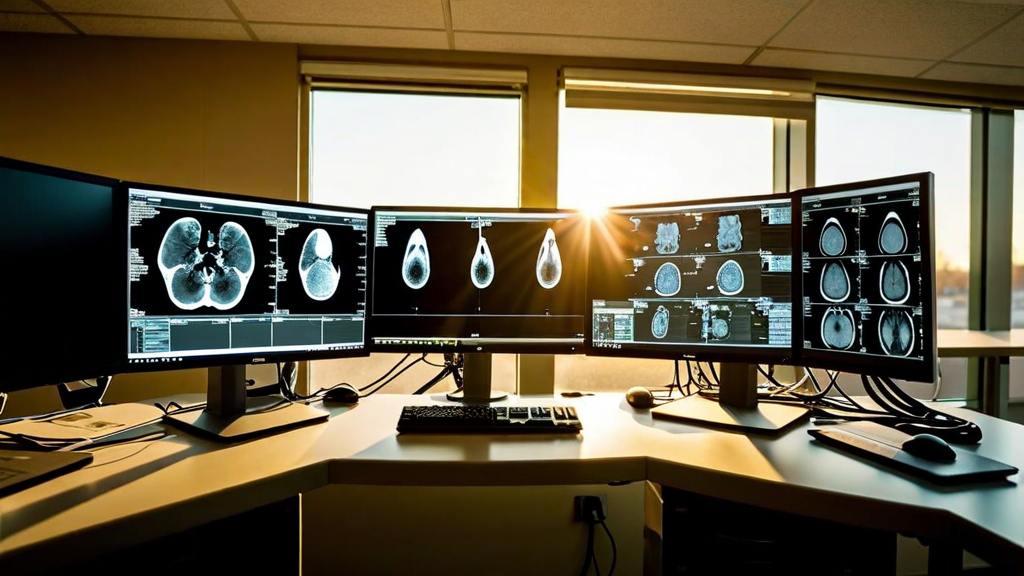
Platform Architecture

On-Site Processing Node

NucliVision deploys a GPU processing node inside the hospital's network perimeter. No PHI leaves the building. The node runs the AI inference pipeline, receives DICOM from PACS, and returns results via standard DICOM protocols.

Hardware: NVIDIA RTX 4090 or A5000, 64 GB RAM, NVMe storage. Rack-mounted 1U server, installs in the existing data center.

DICOM Integration Layer

The platform connects to existing PACS using standard DICOM C-STORE and C-FIND. No custom middleware servers, no additional software licenses, no changes to the PACS vendor configuration beyond adding a DICOM AE title.

Supported PACS: Sectra IDS7, Philips iSite, GE Centricity, Agfa IMPAX, Intelerad IntelePACS, Fujifilm Synapse.

AI Model Stack

Three independent AI modules operate as a pipeline: image enhancement runs first (denoising, resolution recovery), followed by quantification extraction (SUV analysis, organ segmentation), followed by report population (structured output generation).

Framework: PyTorch inference engine, ONNX runtime for deployment, custom DICOM-ML bridge library.

Clinical Workflow Integration

The platform is invisible to technologists and minimally disruptive for physicians. That is by design.

Technologist workflow - unchanged

The gamma camera technologist finishes the acquisition, runs QC, and sends to PACS as usual. The NucliVision node receives the DICOM automatically via a pre-configured DICOM routing rule. No technologist action required. No training needed for technologists.

From the technologist's perspective: the scan goes to PACS, and a few minutes later there is an additional series in the study labeled "NucliVision Enhanced." That is the only visible change.

Physician workflow - minimal change

The nuclear medicine physician opens the study in their existing PACS viewer. They see the original acquisition series plus the NucliVision enhanced series. No new application, no new viewer, no additional login.

If the report generation module is enabled, a structured draft report appears in the dictation system pre-populated with quantitative findings. The physician reviews, edits, and signs. Most physicians at our beta sites report it as "opening a report someone started for me."

Typical time from scan completion to enhanced images in PACS: 3-7 minutes

This is faster than the typical delay between scan completion and the physician opening the study for reading - meaning enhanced images are available before the radiologist begins review in most departments.

Security and Compliance

HIPAA

All PHI processed on-site. BAA available. Annual HIPAA compliance audit. No cloud transmission of patient data.

Data Security

AES-256 encryption at rest. TLS 1.3 for all internal network communication. Role-based access controls with audit logging.

IEC 62304

Medical device software lifecycle documentation current. Software of Medical Device (SaMD) classification: Class IIa. Full change management and version control.

FDA Pathway

510(k) pre-submission meeting completed. Predicate device identified. Clinical validation study ongoing at two academic medical centers.

FDA Regulatory Strategy

NucliVision's image enhancement module is pursuing FDA 510(k) clearance as an AI-enabled medical device for nuclear medicine image post-processing. The predicate device is a cleared SPECT image reconstruction and post-processing system.

The pre-submission meeting with FDA's Digital Health Center of Excellence was completed in Q3 2024. FDA confirmed the 510(k) pathway is appropriate and provided guidance on the clinical evidence required for substantial equivalence.

Clinical validation is ongoing at Beth Israel Deaconess Medical Center and Massachusetts General Hospital. The study protocol: blinded reader study, 8 nuclear medicine physicians, 300 cases per modality (FDG PET, DOTATATE SPECT, bone scan). Primary endpoint: diagnostic confidence score on a 5-point Likert scale, non-inferiority to original scan.

Interim analysis completed at 150 cases shows the enhanced images are rated diagnostically superior or equal to original images in 97% of cases, and superior in 68% of cases for lesion characterization tasks.

FDA Regulatory Pathway

Integration Specifications

Input requirements

  • DICOM CT, PT, NM modalities accepted
  • Reconstruction: OSEM, MLEM, TOF-OSEM (vendor-specific implementations supported)
  • Minimum study size: 50 MB. No upper limit.
  • DICOM version 3.0 required
  • CT attenuation correction map required for quantitative PET processing

Output formats

  • DICOM Secondary Capture (enhanced image series)
  • DICOM Structured Report (quantitative measurements)
  • HL7 CDA document (dosimetry and report output)
  • PDF report (for printing and EMR attachment)
  • JSON API endpoint for custom integrations

Network requirements

  • Processing node inside hospital network (no internet connection required)
  • DICOM port: configurable (default 11112)
  • Management interface: HTTPS on port 8443
  • Remote monitoring: optional, outbound HTTPS only, no PHI transmitted

Supported scanners

  • Siemens Biograph mCT, Vision, Quadra
  • GE Discovery MI, IQ, 670 Pro
  • Philips Vereos, Ingenuity TF
  • United Imaging uEXPLORER, uMI
  • Mediso AnyScan, nanoScan

Ready to evaluate NucliVision in your department?

Installation takes one day. Evaluation period is 60 days. We provide clinical support throughout.

Start an Evaluation View Solutions